
LOSING THE PLOT
"THE WHITE ALBUM" - NARRATIVE BREAKDOWN: THE STRAIGHT STORY

Joan Didion imagines a naked woman on the ledge of a 16th floor window. How did she get there? The image appears in the first paragraph of her essay “The White Album”. It follows Didion’s famous declaration, “We tell ourselves stories in order to live.” Perhaps this woman could use a good story.
Didion proposes several alternative narratives to make sense of this potential suicide: “The naked woman on the ledge outside the window...is a victim of accidie, or the naked woman is an exhibitionist, and it would be ‘interesting’ to know which.”
‘Accidie’ is a curious word; it originates in Latin and its specific literary reference is Psalm 91.7 where it is the “destruction that wastes at noonday.” Also, known as “the noonday demon” - a state that afflicts its sufferers with depression alongside restlessness, especially in the noonday heat of desert monastic communities in the early Christian era, or in “the Sixties,” in Hollywood, when lo-cal psycho-technical terminology explains nothing. Even now, there are victims. I have met them. I am one.
It’s characteristic Didion to reach for the precision and force of ancient terms coined when people had souls and lost them. It’s appropriate to her condition in 1967, before starting the essay in her collection, “Slouching Toward Bethlehem” when she fought migraines with a mixture of gin, hot water and Dexedrine to banish the noonday demon long enough to find a reason to write:
It was the first time I had dealt directly and flatly with the evidence of atomisation, the proof that things fall apart: I went to San Francisco because I had not been able to work in some months, had been paralysed by the conviction that writing was an irrelevant act, that the world as I had understood it no longer existed. If I was to work again at all, it would be necessary for me to come to terms with disorder.
Back to “The White Album” where Didion, after riffing on some possible explanations for the potential suicide, makes text of the subtext for narrative, “We look for the sermon in the suicide, for the social or moral lesson in the murder of five.” Narrative comments; narrative opines; narrative offers answers and explanations.
That “murder of five” stands out. This essay was published in New West magazine in the summer of 1979. Ten years before, on 9th August 1969 Sharon Tate, Jay Sebring, and three others were murdered on Charles Manson’s orders by members of his ‘family.’ The driver of the murder car, a Family-member but not a murderer, Linda Kasabian, testified against Manson and others in his cohort, and put them in prison for life. Kasabian escaped a life sentence in prison; it appears she never escaped her guilt.
The essay in “The White Album” might be supposed to report on the meaning of the “murder of five” and the two others, Leno and Rosemary La Bianca murdered the next night. After all, Didion made her name by embedding in 1967 with the ‘hippies’ and producing the first evidence of her clairvoyant prose diagnoses of the current social malaise in her landmark essay “Slouching Toward Bethlehem”. It would have been a fair expectation that she would bring that same clairvoyance and acid prose to the Manson Murders, dissolving the lies, revealing the monster.
But in “The White Album” Didion swerves the expected focus on the Murders. She uses fragments of her interviews with Kasabian, before and after the trial, and later when Didion and Kasabian visited each other’s homes and families. But she’s not the story. Manson doesn’t get a look in.
There’s more to the story: Kasabian agreed that Didion should write a book telling Kasabian’s story and how her path led to witnessing both nights of murder.
Didion abandoned the book. I read “The White Album” as an essay implicitly telling the reader why. Narrative is not up to understanding this world and its fragmentation. She instead shows the reader how the world stops making sense. She’s too honest to fabricate a narrative. Narrative just breaks down. She’s honest in her portrayal of how she breaks down, too.
Do stories save lives? Didion didn’t say that. She writes that we tell ourselves stories so that we can continue to live. She uses narrative form to show that its breakdown leaves only story. That begs the question: can we hold it together to write our story?
In March of this year, the New York Public Library opened the 336 boxes of papers that comprise the Didion-Dunne Archive. From a report in the Washington Post, Lesley M. M. Blume learns the reason why Didion abandoned the project:
Didion did privately acknowledge that the definitive “why” behind the ordeal remained elusive to her, even after the many hours she spent with one of the saga’s protagonists.
‘Everything that came to my attention about situations with Linda came down to the same thing: the paradox, the ordinariness of the situation and the extraordinariness of the fact, the mystery (in the theological sense) of the night on Cielo Drive,’ she mused in her unpublished notes. ‘I could not penetrate that mystery, or avoid it or evade it or get beyond it.’
Kasabian disappeared and became a recluse, living under at least three different aliases. She appears in an interview with Larry King in 2009. The occasion was the 40th Anniversary of the murders. The presumption is that she needs the money; the word is she lives in penury in a caravan in Tacoma, Washington.
Other writers got there first: Ed Sanders with “The Family”; Gay Talese profiled George Spahn who owned Spahn Movie Ranch where Manson and the Family billeted during the commission of their murders and before their escape to Death Valley and eventual capture. Truman Capote looked for an angle, and found one later when he interviews Bobby Beausoleil at San Quentin. It runs as a transcript with a brief introduction under the title “Then It All Came Down”; I found it in “Music for Chameleons”.
Vincent Bugiosi, the prosecutor, wrote the best-selling true crime book in publishing history, “Helter Skelter: The True Story of the Manson Murders” with Curt Gentry. Bugliosi had no trouble ‘imposing the narrative line’ and ‘freezing the phantasmagoria of actual experience’: he supervised two homicide teams and gathered the evidence that identified Manson. Then he constructed the narrative that convinced the jury to convict Manson and his co-defendants.
Constructing a narrative: to understand what that means and how ‘narratives’ differ from ‘stories’ let’s return to Didion’s essay “The White Album”:
We interpret what we see, select the most workable of the multiple choices. We live entirely, especially if we are writers, by the imposition of a narrative line upon disparate images, by the ‘ideas’ with which we have learned to freeze the shifting phantasmagoria which is our actual experience.
Spoiler alert: Didion never succeeded in finding the narrative line to impose on this material. That material included Kasabian; we know Didion could not write that book. She could not find the sermon, the moral. Notwithstanding the sex and the drugs, the squalor and the gore, it seems, from what Didion writes in her notes that the ordinariness of Kasabian’s life before and after offered only paradox and mystery. The murders themselves appear to have been impossible to imagine or narrativise.
The essay falls apart into fifteen sections or, better, fragments - as the Jena Romantics used the word. Each fragment represents a failed narrative. Chaos defies narrative understanding. I believe this recursive structure arrives at a base case. The breakdown in narrative is in fact a physical and mental breakdown.
After writing that her experience had become a “cutting-room experience” we read ‘Another Flash Cut:’ After this cut, Didion inserts a verbatim psychiatric report of what, despite or because of the medicalese, sounds like a nervous breakdown.
In a one-two combination, Didion recounts another diagnosis, albeit exclusionary, of multiple sclerosis:
I had, at this time, a sharp apprehension not of what it was like to be old but of what it was like to open the door to the stranger and find that the stranger did indeed have a knife...the startling fact was this: my body was offering a precise physiological equivalent to what had been going on in my mind. ‘Lead a simple life,’ the neurologist advised. ‘Not that it makes any difference we know about.’ In other words it was another story without a narrative.
Her body takes over from the narrative and becomes the story. There’s an equivalence between events inside and outside her, the interface between them becomes this essay.
Here’s how it works:
What happens appears to be this: as the lining of a nerve becomes inflamed and hardens into scar tissue, thereby blocking the passage of neural impulses, the nervous system gradually changes its circuitry, finds other, unaffected nerves to carry the same messages. During these years when I found it necessary to revise the circuitry of my mind I discovered that I was no longer interested in whether the woman on the ledge outside the window on the sixteenth floor jumped or did not jump, or in why. I was interested only in the picture of her in my mind: her hair incandescent in the floodlights, her bare toes curled inward on the stone ledge.
In this light all narrative was sentimental. In this light all connections were equally meaningful, and equally senseless. Try these: on the morning of John Kennedy’s death in 1963 I was buying, at Ransohoff’s in San Francisco, a short silk dress in which to be married. A few years later this dress of mine was ruined when, at a dinner party in Bel-Air, Roman Polanski accidentally spilled a glass of red wine on it. Sharon Tate was also a guest at this party, although she and Roman Polanski were not yet married. On July 27, 1970, I went to the Magnin-Hi Shop on the third floor of I. Magnin in Beverly Hills and picked out, at Linda Kasabian’s request, the dress in which she began her testimony about the murders of Sharon Tate Polanski’s house in Cielo Drive. ‘Size 9 petite…
…I believe this to be an authentically senseless chain of correspondences, but in the jingle-jangle morning of that summer it made as much sense as anything else did.
In England we’d say, she’s lost the plot:
I am talking here about a time when I began to doubt the premises of all the stories I had ever told myself...I was supposed to have a script, and had mislaid it...I was meant to know the plot, but all I knew was what I saw: flash images...not a movie, but a cutting-room experience.
Didion interposes here another allusion, like ‘the murder of five,’ it’s a kenning reference to a touchstone of world literature. It’s meant to put her experience into the frame of literary context and so convey intellectual comprehension and control:
In what would probably be the middle of my life I wanted still to believe in the narrative and narrative’s intelligibility...”
Compare “in the middle of my life” to the opening of the “Divine Comedy” where Dante, in a dark wood, pursued by a ravening beast, stands cornered on the verge of the “Inferno”:
Midway in our life’s journey, I went astray from the straight road and woke to find myself alone in a dark wood. How shall I say what wood that was! I never saw so drear, so rank, so arduous a wilderness! Its very memory gives a shape to fear.
Alighieri, Dante. The Divine Comedy (The Inferno, The Purgatorio, and The Paradiso) (p. 45). (Function). Kindle Edition.
Rather than the reassuring Christian narrative that provides coherence to Dante’s descent into Hell and reassurance that he will resurface and proceed through Purgatory to Paradise and redemption, Didion has her sister-in-law’s swimming pool in Beverly Hills:
A demented and seductive vortical tension was building in the community. The jitters were setting in. I recall a time when the dogs barked every night and the moon was always full. On August 9, 1969, I was sitting in the shallow end of my sister-in-law’s swimming pool in Beverly Hills when she received a telephone call from a friend who had just heard about the murders at Sharon Tate Polanski’s house on Cielo Drive. The phone rang many times during the next hour. These early reports were garbled and contradictory. One caller would say hoods, the next would say chains. There were twenty dead, no, twelve, ten, eighteen. Black masses were imagined, and bad trips blamed. I remember all of the day’s misinformation very clearly, and I also remember this, and wish I did not: I remember that no one was surprised. [J.D. italics, not mine.}
The distortions - barking dogs, continuous full moons - are brief mitigations of the dead-eyed fixity of Didion’s gaze: She allows her prose to verge into gothic expressionism to the capture the proliferating nightmare as the numbers of the dead escalate. Hoods and chains appear. Undisciplined imaginations manufacture set designs of the crime scene and skipped invitations to Cielo Drive that night.
Didion cuts to the ‘story,’ circumventing ’narrative’ to achieve the base case beneath the distortions and the brushfire rumours. Her story is the raw fear of death: the front door, the intruder, her daughter asleep upstairs.
It will perhaps suggest the mood of those years if I tell you that during them I could not visit my mother-in-law without averting my eyes from a framed verse, a ‘house blessing,’ which hung in the hallway of her house in West Hartford, Connecticut.
‘God bless the corners of this house,
And the lintel blest -
And bless the hearth and bless the board
And bless each place of rest -
And bless the crystal windowpane that lets the starlight in
And bless each door that opens wide, to stranger as to kin.
This verse had on me the effect of a physical chill, so insistently did it seem the kind of ironic detail the reporters would seize upon, the morning the bodies were found. In my neighbourhood in California we did not bless the door that opened wide to stranger as to kin. Paul and Tommy Scott Ferguson were the strangers at Ramon Novarro’s door, up on Laurel Canyon. Charles Manson was the stranger at Rosemary and Leno LaBianca’s door, over in Los Feliz. Some strangers at the door knocked and invented a reason to come inside: a call, say, to the Triple A, about a car not in evidence. Others just opened the door and walked in, and I would come across them in the entrance hall. I recall asking one such stranger what he wanted. We looked at each other for what seemed a long time, and then he saw my husband on the stair landing. ‘Chicken Delight,’ he said finally, but we had ordered no Chicken Delight, nor was he carrying any. I took the license number of his panel truck...
Sharon Tate’s story cannot be told, nor those of other victims. These intruders murdered narrative sense and meaning. No books can be written. No articles suffice.
Only I alone am escaped to tell thee.
-Book of Job, Moby Dick, H. Melville
So many encounters in those years were devoid of any logic save that of the dreamwork.
-Didion, The White Album
Logic has little ability to manage the threads of raw story to which one must clutch when standing on the ledge, where nightmares come true. Like the five-year-old girl Didion reads about in Hawaii where she’s resting her nerves, where nonetheless the news penetrates of Bobby Kennedy’s assassination, of the My Lai Massacres, and of -
Betty Lansdowne Fouquet, a 26-year-old mother with faded blonde hair who put her five-year-old daughter out to die on the centre divider of Interstate 5 some miles south of the last Bakersfield exit. The child, whose fingers had to be pried loose from the Cyclone fence when she was rescued twelve hours later by the California Highway Patrol, reported that she had run after the car carrying her mother and stepfather and brother and sister for ‘a long time.’ Certain of these images did not fit into any narrative I knew.
Didion’s proximity to the naked woman on the ledge has become, as we read, imprinted on her nerves. It’s a measure of Didion’s art but, more, of her character that she does not look down. Or jump. Despite the feel of toes curling around the stone ledge, Didion serves the story straight, with no narrative chaser.
‘Narrative’ in our time has become a shiny word for dirty business, politics, spin, framing. Stories are what my mother told me when I was having nightmares; they are the stories I told my sons.
Didion writes that we tell stories in order to live. Didion at the end of her life found another way to express this urgent desire - to keep the memory of your dead child alive, for as long as you have time to write their story.
NY Times reporter Lauren Christensen found this:
Didion kept a stack of undated, printed pages she titled simply “NOTES.” Around 20 pages in all, the pages are numbered, but some numbers repeat, suggesting she’d originally written them as separate documents, and perhaps later stashed them together. The notes within pertain not only to “Blue Nights,” but also to 2005’s “The Year of Magical Thinking,” her National Book Award-winning account of another death that overlapped in time with Quintana’s — her husband John’s.
What happened, chronologically, was this: On Christmas 2003, Quintana was hospitalized for a flu that turned into pneumonia that turned into a coma. Five days later, upon returning home from visiting his unconscious daughter in the I.C.U. on Dec. 30, Dunne died suddenly, at the dinner table, of a heart attack that had been foretold for years but was nonetheless over in the span of an “ordinary instant,” as Didion wrote in the 2005 book.
A year and a half later, on Aug. 26, 2005, after a torturously protracted series of health emergencies whose precise causes Didion leaves somewhat opaque (the Christmas flu that turned into pneumonia then turned into septic shock, and eventually into a cerebral hemorrhage), Quintana died too.
I write about this because otherwise I would be dead,” Didion typed in the “NOTES” document. “This is not a book I want to finish. When I finish we will be finally apart.”
I started this newsletter to recover from my son’s death. There is no recovery. “I write for myself and for my friends, and I write to ease the passing of time,” Borges wrote.
Why Manson you might ask? Because I shook hands with Jay Sebring a few months before he was strung up beside the woman he loved and saw her die as they were butchered by the Manson Family. It’s possible that a galvanic charge passed from him to me, and Didion’s essay and the appalling pathos of Linda Kasabian’s story discharges it from its hideaway in my unconscious mind.
In the next essay, I will continue to explore the many threads of narrative that form a Text (Latin ‘textere’, or ’to weave’) When we use narrative understanding to find a living handhold to keep our balance as our story unfolds. ,
The Greeks call them the Fates:
Clotho and Lachesis, spun and measured the thread of life, Atropos was responsible for cutting it, thereby determining the precise moment of an individual's death.
Here Goya pictures the three sisters, the Morai, who measure, weave, and cut the text that becomes our destiny.
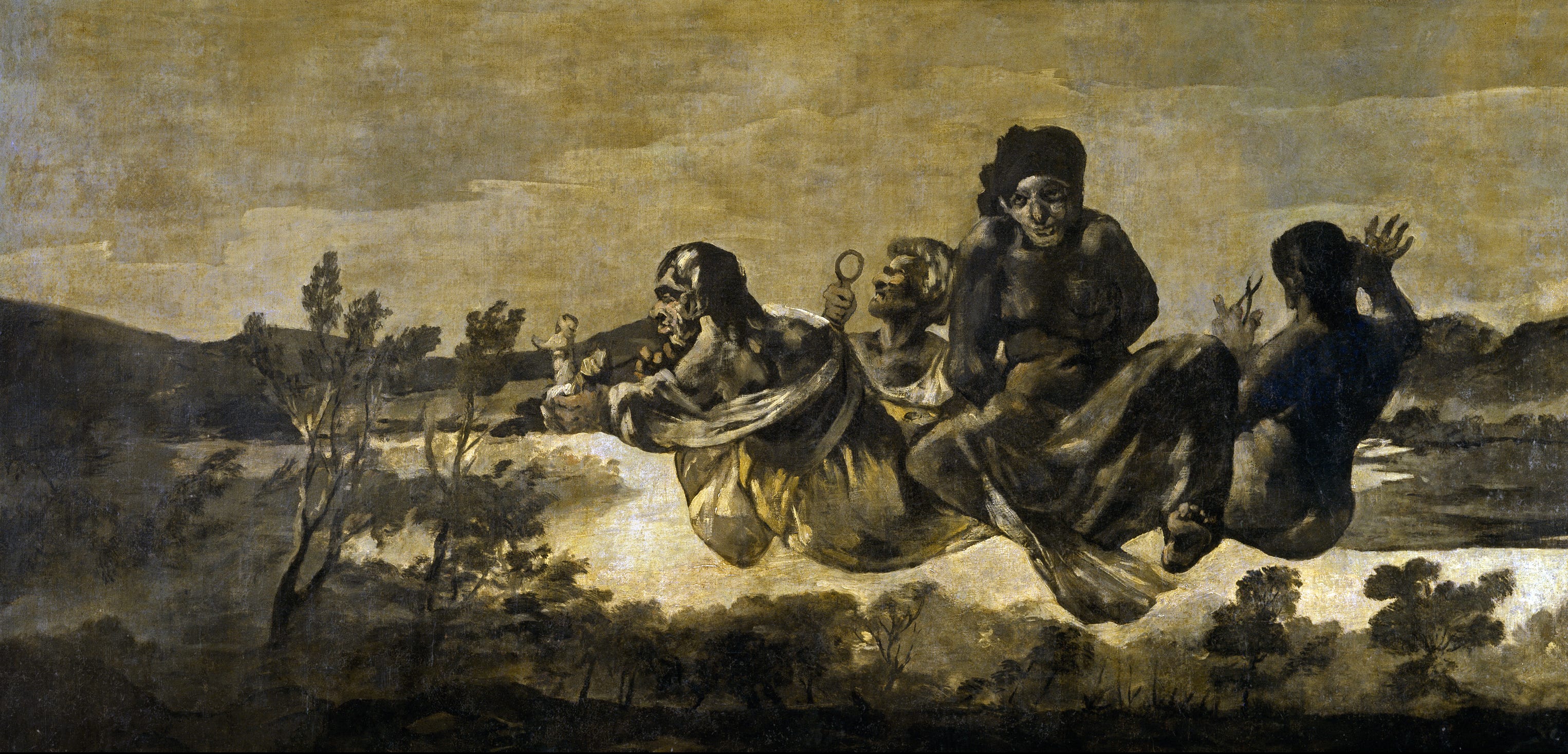
“Atropos,” Goya, Prado - one of the 15 Black Paintings.
Come back for more Didion, more story, and more threads of narrative woven from our storied fates.
Please subscribe.
Excellent essay. Some things cannot and will not be narrative-ized. Some things are beyond the comprehension of the written word or the mind that makes the word, and the words of description themselves are utterly inadequate to the task. The words are secretaries, recording in steno, but without feeling or fidelity. We writers are faced with the impossible, and it may be impossible because we are not like the woman in the ledge -- incandescent and unknowable -- but like Didion on the ground, looking up at a sublimely unknowable thing.